
The steering committee dashboard was green. Data migration had passed its third mock load, and the integrator had just put up a slide that said “Go-Live Readiness: 94%.” Everyone felt good.
About forty miles away, at a quarter past six that same morning, a receiving clerk printed the day’s putaway list, walked it back to her desk, and typed every line into a spreadsheet she’d built years ago. That spreadsheet was how the plant kept track of damaged lots, the suppliers who always shipped short, and the pallets that had to be inspected before anyone could shelve them. Quality relied on it. The buyers checked it before placing orders.
Nobody on the steering committee had ever heard of it. It turned up three weeks after go-live, when she stopped updating it and damaged product started showing up at customers’ docks.
I’ve sat through my share of steering committees, and I’ve seen versions of this story more often than I’d like. The status report gets written in a conference room. What actually happens gets written on the floor.
The promise, and why it slips away
There’s a lot to like about modern ERP. You can see inventory as it moves instead of the next morning. The analytics sit right on the screen where the decision gets made. People can transact on the dock or the line without walking back to a terminal. Standard processes replace decades of custom code, a clean core makes upgrades routine, and AI is starting to take on the exceptions and routine decisions that used to eat up people’s days.
And honestly, this isn't optional anymore. The legacy systems many manufacturers still run on are getting harder to support every year, and the people who know how to keep them going are heading toward retirement. Customers expect accurate delivery promises in real time, supply chains aren't getting any calmer, and AI is only as useful as the data and platform underneath it. The companies that modernize will be able to move faster and see further than the ones that don't. If you're still on the fence, my advice is simple: don't wait for the old system to force your hand. Start the journey now, and start it the right way.
So why do so many companies go live and then spend the next year wondering where the benefits went?
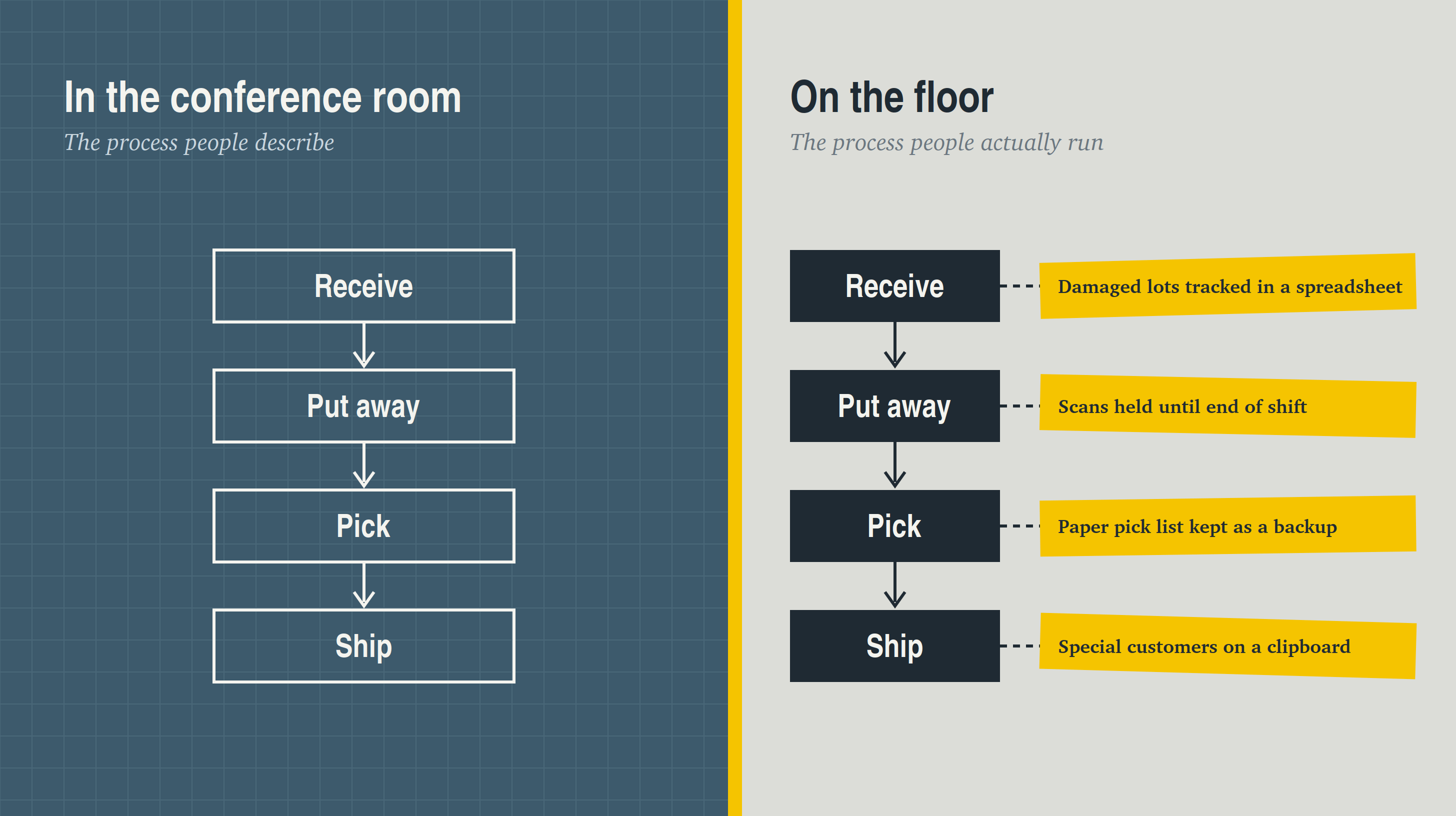
In my experience, it’s rarely the software. It’s where the design happened. Workshops capture the process people describe, and that’s almost never quite the process they run. The people doing the work a thousand times a week usually aren’t in the room. Their manager is. The exceptions get smoothed over, and the workarounds don’t come up at all, sometimes because the manager doesn’t know about them, and sometimes because nobody wants to admit in front of a VP that the official process doesn’t really work.
What happens next is predictable. The old process moves onto the new platform, workarounds and all. Customizations sneak back in to make things feel familiar, and the clean core gets messy fast. You end up with a modern system running an organization that hasn’t changed.
Here’s the thing I wish more programs understood: the workarounds are the requirements. Every spreadsheet, sticky note, and re-keyed field is telling you exactly where the system doesn’t fit the work. Ignore them and you’ll rebuild the same gaps on a more expensive platform.
Gemba
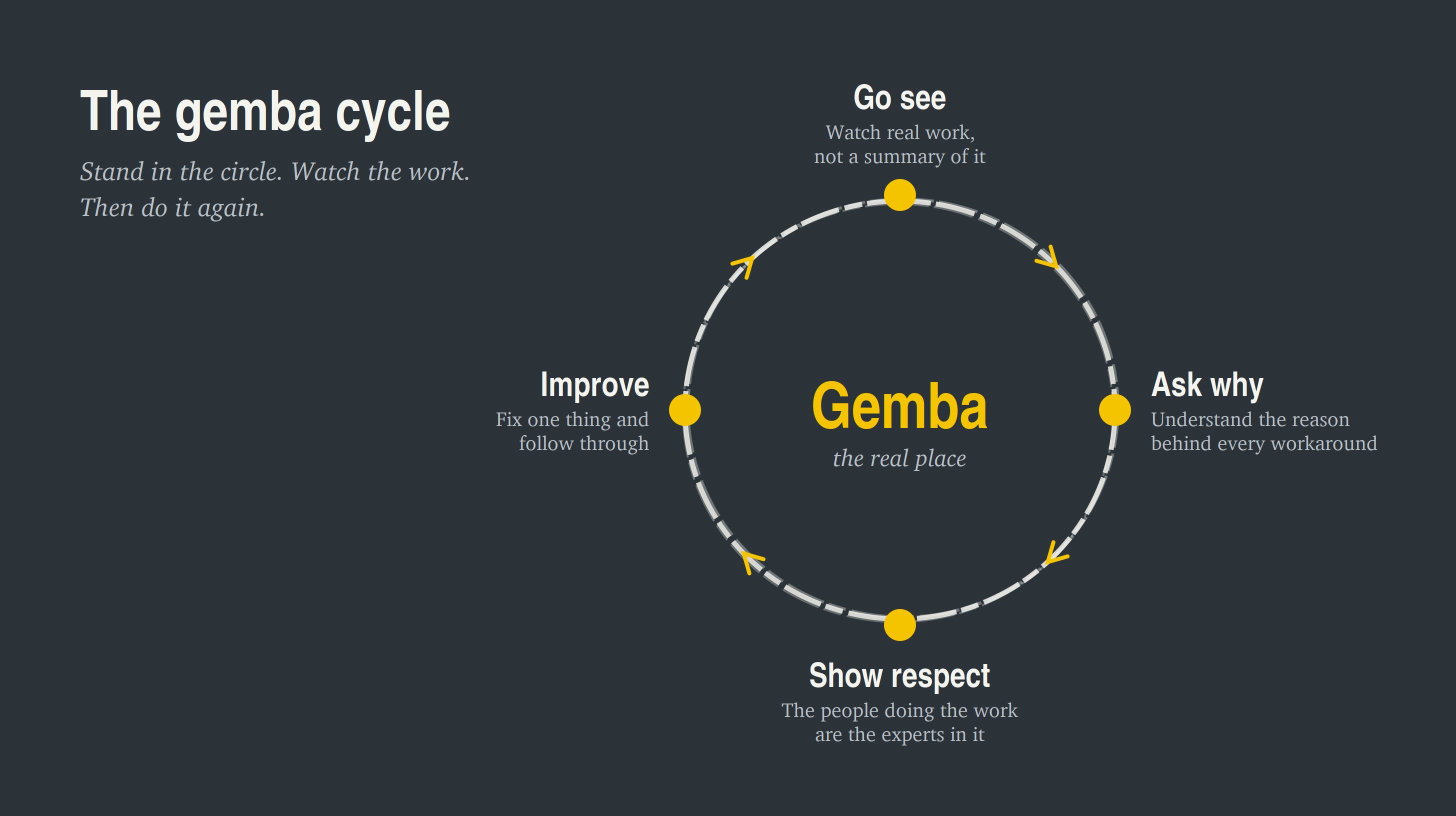
Manufacturing figured this out a long time ago. In the Toyota Production System, gemba means “the real place,” where the work actually happens. If you want to improve something, you go there and look.
There’s a story that Taiichi Ohno would chalk a circle on the factory floor, put a young manager inside it, and leave them there for hours. Just watching. Eventually they’d start noticing the waste that had been right in front of them all along.
The idea is simple: go see for yourself, ask why things are done the way they are, and respect the people doing the work, because they know it better than you do. Then fix something, and go back and look again. That loop is what the Japanese call kaizen, and it’s exactly what an ERP journey needs.
How gemba gets you to modern ERP
Nearly every benefit modern ERP promises depends on something you can only see from the floor. A few examples make the point better than I can.
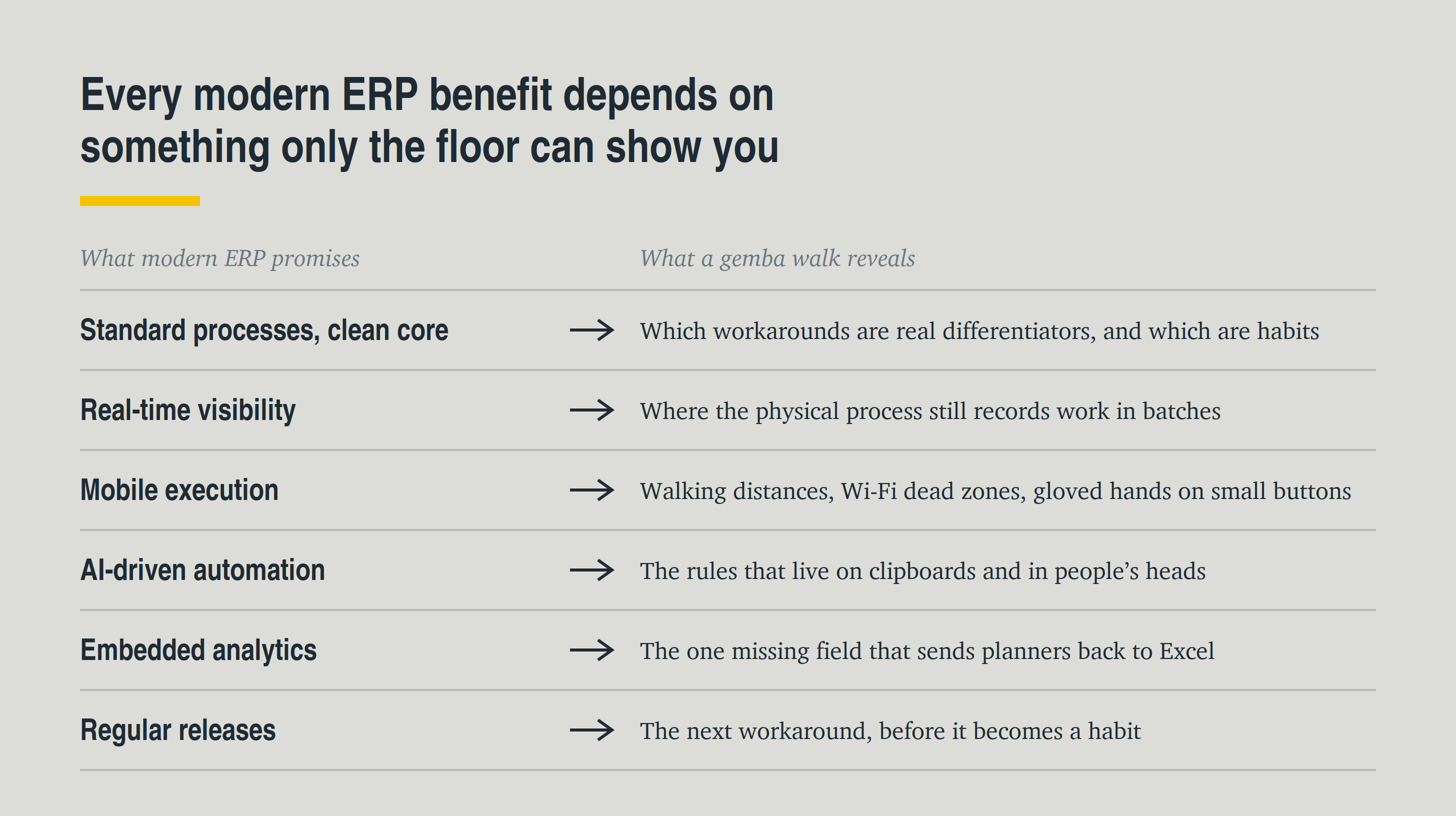
Take clean core. It sounds great until the business insists every one of its quirks is a competitive advantage. At one distributor, sales came into workshops with more than forty customer-specific pricing rules, each supposedly critical. The debate went on for weeks. Then someone spent an afternoon watching customer service enter real orders. They used a handful of the rules. Several belonged to customers who hadn’t ordered in years. Most of the rules were retired, and the argument was over within days. It’s hard to fight what you’ve watched with your own eyes.
Or real-time inventory. A manufacturer went live with it, and within a month sales stopped trusting the numbers because stock kept showing up hours late. Everyone assumed it was a system problem. It wasn’t. Forklift drivers were saving their scans for the end of the shift, because the scanner batteries died by mid-afternoon and the chargers were at the far end of the building. A few spare batteries and some chargers near the docks, and the problem went away in a week.
Testing is another one. I’ve watched plenty of mobile apps sail through UAT in a training room. At one company, the picking app did exactly that, then fell apart within an hour on the actual floor. The Wi-Fi dropped in the back racking and the cold room. Confirming a pick took seven screens, which doesn’t sound like much until you do it hundreds of times a shift. And nobody could hit the little buttons with gloves on. None of that is a defect a test script will ever catch.
AI raises the stakes further, because you can’t automate what you don’t understand. One company piloting an AI agent to release held orders was thrilled with the early results. Then they spent a morning with the order management team and found a rep’s list of customers whose orders should never go out automatically. One had a dispute pending. One needed a delivery appointment. One wanted everything consolidated weekly. None of it was in the system. The agent would have done everything right by its own logic and gotten it wrong for the business.
And finally, proving the benefits. Six months after one go-live, a planning team’s login numbers looked great. Walk over to their desks, though, and they were exporting everything to Excel, same as before. The standard view was missing the supplier’s confirmed delivery date, the one field they actually cared about. It took a few days to add. The spreadsheets disappeared within a month.
None of this stops at go-live, either. Modern ERP keeps shipping new capabilities, and the habits that got you through the implementation are the same ones that keep you getting better afterward.
How to walk
You don’t need a program office for this. You need to show up and pay attention.
Look for the tells: spreadsheets and clipboards, people typing the same data twice, people waiting, the one person everybody goes to with questions, problems that get solved with a phone call instead of in the system, labels fixed with a pen.
Pick one area, like receiving, order-to-cash, or returns, and go with the process owner, not around them. Let the team know you’re there to learn, not to grade anyone. Ask them to show you instead of tell you, and ask to see what happens when something goes wrong.
The hardest part is not fixing things on the spot. You’ll want to. Don’t. It undercuts the supervisor, and it turns a learning walk into an inspection. Instead, afterward, share what you saw and commit to fixing one thing within a couple of weeks. Even something small. That follow-through is what gets you honest answers the next time you show up.
Your first walk
Block two hours this month. Bring a notebook and a few questions:
Can you show me the last order, receipt, or call you worked?
What do you do when the system won’t let you do what you need?
What do you keep track of outside the system?
If it were up to you, what’s the one thing you’d change?
Then mostly just listen.
Modern ERP can change how a company works. But that change doesn’t get switched on at go-live. It happens on the floor, one process at a time, when the people leading it understand the work well enough to redesign it.
So get out of the conference room. Go stand in the chalk circle for a while. You’ll be surprised what you see.